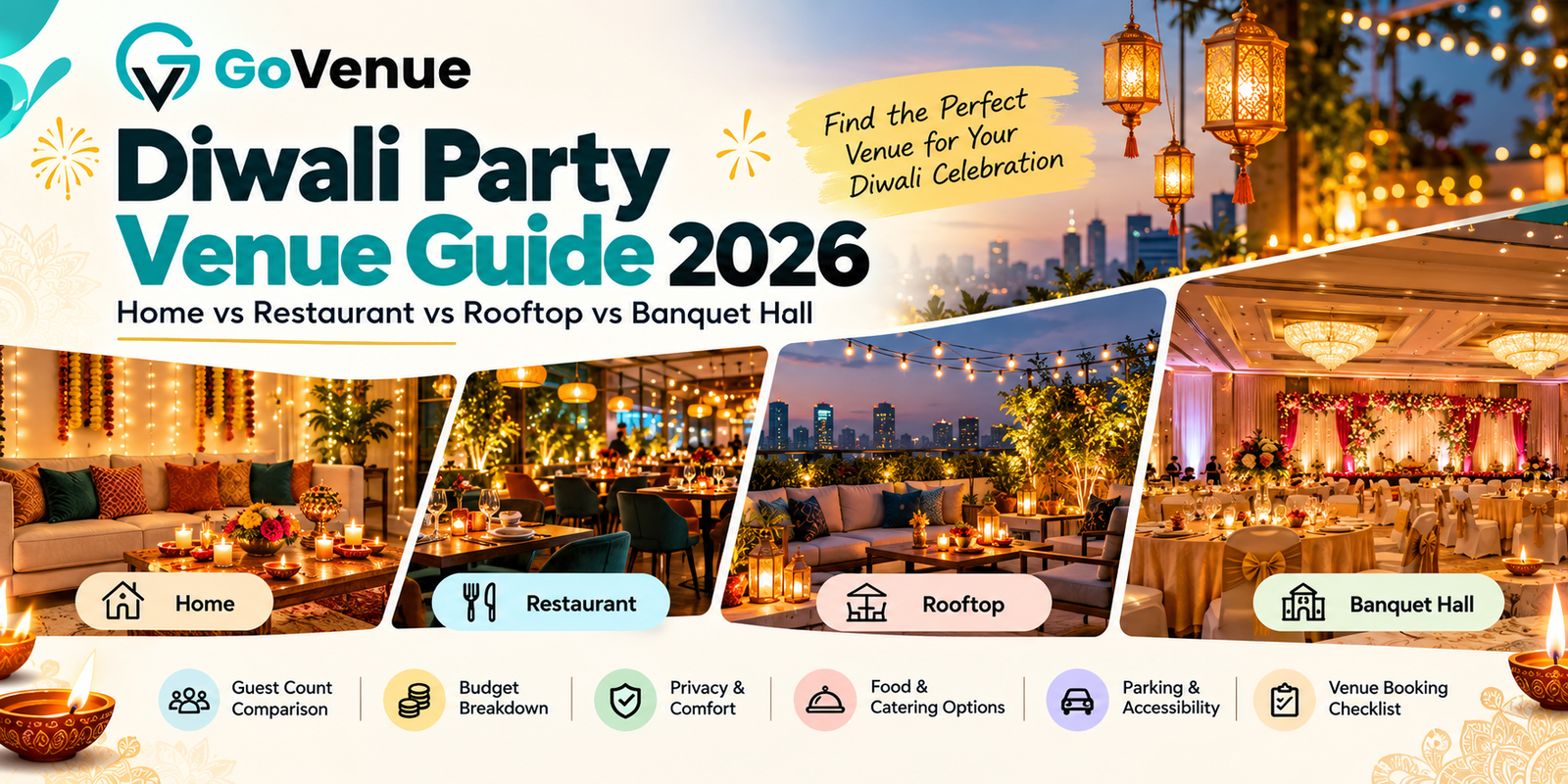
A home gathering may feel personal, a restaurant may make food easier, a rooftop may offer an attractive setting, and a private party hall may give your group more flexibility. But the best option is not necessarily the most expensive, the most decorated or the one with the lowest advertised price.
The right Diwali party venue is the one that fits your guest count, total budget, celebration style and practical needs.
This guide compares five common options—home, café or restaurant, rooftop, small private party hall, and banquet hall—using a practical decision framework. You will also find a venue comparison table, a cost-checking method, a shortlisting scorecard and the questions to ask before paying an advance.
Quick Answer: Which Diwali Party Venue Should You Choose?
- Home: Best when you want a personal gathering and have enough space to host comfortably.
- Café or restaurant: A good option when you want a meal without organising all the food yourself.
- Rooftop: Worth considering when ambience and an open-air setting are central to the experience.
- Small private party hall: Useful when you want a separate space for friends or family without needing a large banquet venue.
- Banquet hall: Often worth shortlisting for larger gatherings that need organised seating, dining and a dedicated event setup.
These are starting points, not fixed rules. A restaurant may offer a private area, a party hall may include catering, and a banquet may be available for a smaller group. Always compare the actual layout, package and terms.
1. Start With the Experience, Not the Venue Photos
Before searching for a Diwali party venue, answer five questions. They will help you eliminate unsuitable options before spending time comparing photographs and quotations.
Question 1: Who is actually coming?
Estimate the number of people likely to attend, not the maximum number you could invite.
A celebration for a couple and close family has different space needs from a gathering of 25 friends or a family event with several generations.
Confirm whether children, older guests or people with mobility requirements will attend. Their seating, access and comfort needs may affect the venue choice.
Question 2: What should the gathering feel like?
Choose your main priority:
A relaxed family evening.
A dinner with friends.
A stylish rooftop gathering.
A private celebration with decoration and games.
A larger event with formal seating and food service.
Write down your two most important requirements. This prevents you from paying for facilities that do not improve the experience you want.
Question 3: What is your total budget?
Set a spending limit before contacting venues. Include more than the headline rental charge.
Depending on the arrangement, you may also need to account for catering, decoration, taxes, service charges, transport, equipment, overtime or cleaning.
Question 4: How much work do you want to manage?
At home, you may have more control but will need to organise food, seating and cleanup yourself.
A restaurant can reduce catering work, while a private hall may allow you to choose the layout or vendors, subject to its rules.
Question 5: What is non-negotiable?
Your list might include privacy, accessible seating, an indoor weather backup, a suitable closing time, outside-catering permission or enough space for activities.
Use these requirements to reject venues that cannot meet your needs, even if their photographs look impressive.
2. Compare Five Diwali Party Venue Options
Option A: Celebrate at Home
A home celebration can be personal and convenient, especially when the guest list is small and your home has enough usable space.
What works well
- Familiar surroundings and a personal atmosphere.
- Greater control over the menu and schedule.
- The option to use decorations and furniture you already own.
- No separate venue-rental charge if you use your own space.
What to think about
Seating, food preparation, serving space, parking, neighbours, cleanup and available washrooms can become difficult when too many guests arrive.
Measure the usable space rather than counting only the available chairs. People need room to move between seating, food and conversation areas.
Choose home when: Your group fits comfortably and you are happy to manage the practical work.
Option B: Book a Café or Restaurant
A café or restaurant can work well for couples, families and groups of friends who want to meet over a meal.
What works well
- Food and service may already be organised.
- You may not need to arrange tables, kitchen equipment or cleanup.
- A restaurant reservation can keep the gathering relatively simple.
What to think about
A standard table reservation may not provide privacy or freedom to decorate. Some packages have minimum-spend requirements, set menus, time limits or restrictions on outside food.
Before reserving, ask whether your group will have a normal table, a semi-private area or an exclusive section. These arrangements are not interchangeable.
Choose a café or restaurant when: Dining and convenience matter more than controlling every part of the setup.
Option C: Plan a Rooftop Celebration
A rooftop venue may appeal to groups that want city views, open-air seating and a distinctive evening atmosphere.
What works well
- The setting can make photographs and the overall ambience more memorable.
- It can suit a small dinner or a gathering with friends.
- Decorative lighting may already be part of the venue.
What to think about
The actual experience depends on weather, wind, seating comfort, noise restrictions and the availability of backup space.
Do not assume an open rooftop guarantees an unobstructed view or suitable conditions throughout the evening. Ask what happens if the weather changes and whether an indoor alternative is included.
Choose a rooftop when: The atmosphere is important and the venue can comfortably accommodate your group.
Option D: Reserve a Small Private Party Hall
A small private party hall can be a useful middle ground between hosting at home and booking a larger banquet venue.
It may suit a gathering with friends, a family get-together or a private celebration where you want some freedom over seating and decoration.
What works well
- A separate space for your group.
- More room for organised seating, food and conversation than a typical restaurant table.
- Potential flexibility for decoration, music or outside vendors.
What to think about
Private use, setup time, catering permissions and included facilities vary by venue. A low rental fee may exclude tables, cleaning, sound equipment or additional setup hours.
Ask for the actual floor layout and confirm the number of guests the venue can accommodate comfortably in your intended arrangement.
Choose a small private hall when: Privacy and control over the gathering matter, but a large banquet hall would be unnecessary.
Option E: Book a Banquet Hall
A banquet hall may be worth considering for larger family gatherings or celebrations requiring organised dining, dedicated seating and a more structured setup.
What works well
- Tables, chairs and event facilities may be available as part of a package.
- The venue may offer catering and decoration services.
- A dedicated layout can make guest movement and food service easier.
What to think about
Ask about minimum guest guarantees, meal packages, service charges, decoration restrictions, event duration, sound limits and cancellation terms.
A hall that looks spacious in its photographs may have a different usable layout once dining tables, a stage or other equipment are included.
Choose a banquet hall when: Guest capacity, organised dining and a dedicated event setup are more important than keeping the gathering extremely small or informal.
3. The Venue Comparison Table
Use this comparison to create your first shortlist. The final decision should depend on the specific venue and package—not the category name alone.
Venue Fit Guide
| Venue type | Best suited for | Main advantage | Main trade-off |
|---|---|---|---|
| Home | Small, personal gatherings | Control over the setting | Hosting and cleanup work |
| Café or restaurant | Couples and dining-focused groups | Convenient food service | Limited privacy or decoration flexibility |
| Rooftop | Groups prioritising ambience | Open-air setting and views | Weather and sound restrictions |
| Small private party hall | Private friend and family gatherings | Separate space | Facilities may cost extra |
| Banquet hall | Larger or more structured gatherings | Organised seating and event setup | Minimum guarantees and package conditions |
A practical shortlist by group size
Use guest count as a first filter, not as a guarantee of venue suitability.
- 2–8 people: Start by comparing home and restaurant options.
- 8–20 people: Compare home, restaurant reservations and smaller private spaces.
- 20–50 people: Consider a restaurant's reserved area or a private party hall; check actual seating and movement space.
- 50 or more: Shortlist larger private venues or banquet halls, but verify the layout, package minimum and comfortable capacity.
These are indicative planning bands created to help you begin your search. A spacious home or restaurant may accommodate more people, while a smaller hall may have limited usable space.
4. The True Cost Check: Don't Compare Only the Starting Price
One common booking mistake is choosing the venue with the lowest advertised price without comparing what each package includes.
A per-person price can look inexpensive but may come with a minimum billing requirement. Another venue may charge more per person but bill only for the guests you confirm.
Calculate the total cost before choosing
Use this formula:
Estimated total event cost = base venue/package charge + mandatory charges + food not included + decoration/equipment + additional services + contingency.
Then calculate:
Estimated cost per expected guest = estimated total event cost ÷ expected attendees.
Use the same method for every venue so that you are comparing like with like.
Example: The lower price is not always the cheaper option
Imagine your group expects 22 guests and you receive two hypothetical quotations:
Venue A
- Advertised package: ₹900 per person.
- Minimum billing: 40 people.
- Base package bill: 40 × ₹900 = ₹36,000.
Venue B
- Package: ₹1,200 per person.
- No minimum billing in this hypothetical example.
- Base package bill: 22 × ₹1,200 = ₹26,400.
Venue B has the higher quoted per-person price, but its base package bill is ₹9,600 lower for this group.
These figures are a mathematical illustration, not current market rates or actual venue quotations. Decoration, taxes, service charges and other conditions would still need to be compared before deciding.
The lesson: Always compare the total amount you expect to pay, not just the starting price.
The quote-comparison checklist
Ask each venue to confirm these items in writing:
- Rental or package price.
- Minimum guest count or minimum spend.
- Food, beverages and service included.
- Applicable taxes and mandatory charges.
- Decoration and equipment included or extra.
- Setup and cleanup time.
- Overtime rates and closing time.
- Outside catering or vendor charges.
- Advance payment and cancellation terms.
This makes it easier to spot price differences that are not obvious in an advertisement.
5. The GoVenue Venue Fit Scorecard
A venue can look beautiful and still be wrong for your celebration. Use this simple GoVenue planning scorecard to assess each shortlisted space before paying a deposit.
This is a practical planning tool for this guide—not an industry certification or a third-party venue rating.
Score each category from 0 to 2:
1. Group Fit
- 0: The venue does not comfortably fit the expected guest count or layout.
- 1: It may work, but seating or movement needs further checking.
- 2: The layout suits your group and planned activities.
2. Full-Cost Clarity
- 0: Important costs or minimum charges are unclear.
- 1: You have a partial quote but need clarification.
- 2: The expected total and package inclusions are documented.
3. Experience Fit
- 0: The space does not support the celebration you want.
- 1: It can work with adjustments.
- 2: The setting, facilities and atmosphere suit your plans.
4. Rules and Flexibility
- 0: Important needs such as food, decoration or timing conflict with the venue's rules.
- 1: Some conditions need further confirmation.
- 2: The venue has confirmed that your planned arrangements are allowed.
5. Access and Backup
- 0: Important access, safety or backup arrangements are missing.
- 1: Some details remain unconfirmed.
- 2: Access, exits, relevant safety arrangements and weather backup where needed are clear.
Interpret Your Score
- 8–10 points: A promising shortlist candidate, provided all essential conditions are confirmed.
- 5–7 points: Ask more questions or inspect the venue before making a decision.
- 0–4 points: Resolve the major concerns before paying a deposit; consider another option if the gaps cannot be fixed.
A high score is not proof of quality. Use it to organise your comparison, then verify the venue's claims and written terms.
6. Which Venue Should You Choose for Your Celebration Style?
Sometimes two venues appear equally suitable. In that situation, decide based on the experience you want rather than choosing the more impressive photographs.
For a relaxed family evening
Start with home or a restaurant. Prioritise comfortable seating, easy access and an arrangement that suits guests of different ages.
For a dinner with friends
Compare a restaurant, rooftop or small private hall. The key questions are whether your group can sit together, whether the booking time is sufficient and whether additional charges apply.
For a private Diwali gathering
A small party hall may be worth the extra cost if privacy, decoration or flexible seating is important. Confirm whether the space is exclusive to your group.
For a larger family celebration
Shortlist banquet halls or larger private venues. Check the actual seating layout, minimum guest requirement, meal package and how guests will move between dining and social areas.
For a photo-friendly celebration
A rooftop, decorated restaurant or home setup can work. Check the real lighting, background, crowding and whether photography or additional decoration is allowed.
There is no single venue type that is best for every Diwali party. The right choice is the one that fits your priorities without introducing costs or limitations you did not expect.
7. What to Check During a Venue Visit
If possible, inspect your top choices before making the final payment.
During the visit, do not look only at the entrance or the main photo area. Walk through the entire guest journey.
Arrival: Where will guests enter, park or get dropped off?
Seating: Can everyone sit comfortably? Will the arrangement allow people to move around?
Food: Where will food be served, and could the queue block seating or access?
Sound: Are there restrictions on music, speakers or the event's finishing time?
Facilities: Are washrooms, ventilation or air-conditioning, lighting and accessible routes suitable for your group?
Decoration: What is allowed, and how early can the setup begin?
Safety: Are exits clear? Are electrical cables secured? What rules apply to candles, diyas or other open flames?
Backup: If the venue is outdoors, is there a practical alternative if the weather changes?
8. Questions to Ask Before Paying an Advance
Before confirming a Diwali party venue, ask the manager:
1. What is the final amount payable, including mandatory taxes and charges?
2. Is there a minimum guest count or minimum spend?
3. Which food, seating, decoration and equipment items are included?
4. Can our group bring outside food, decorations or other vendors?
5. What are the setup time, event duration and closing-time rules?
6. What happens if attendance changes or the event needs to be cancelled?
7. Is the deposit refundable, partially refundable or non-refundable?
8. Are music, lighting, candles or diyas allowed under the venue's rules?
9. Is parking available, and are there any additional charges?
10. Can all agreed inclusions and conditions be shared in writing?
Do not rely only on a verbal promise. Keep the quotation, booking confirmation, payment receipt and agreed terms together.
9. A Simple Diwali Venue Planning Timeline
If you are planning for Diwali 2026, the available time may be limited. A simple timeline can still help you stay organised.
First: Decide the essentials
Confirm the likely guest count, budget ceiling, preferred date and two or three essential requirements.
Next: Shortlist two or three venues
Choose options that meet your minimum requirements instead of contacting every venue in your area.
Then: Compare complete quotations
Use the True Cost Check and Venue Fit Scorecard from this guide. Ask each shortlisted venue the same core questions.
Finally: Confirm the written booking
Review the package, payment conditions, cancellation policy, event duration and setup permissions before paying.
If your preferred venues are unavailable, adjust the venue type or date only if it still works for your group. Do not make a rushed payment to a venue that cannot meet your essential requirements.
Which is the best venue for a Diwali party?
The best venue depends on group size, budget, privacy and the type of celebration. Home may suit a personal gathering, restaurants work well for dining, rooftops suit open-air ambience, and private party halls or banquet venues may suit groups that need dedicated space.
Is a rooftop better than a banquet hall for Diwali?
Not always. A rooftop may offer an open-air setting and attractive views, while a banquet hall may provide more predictable indoor arrangements. Compare comfort, weather backup, seating, cost and venue rules.
Is a private party hall worth booking for a small Diwali celebration?
It may be worth the additional cost if you want privacy, decoration flexibility or a separate space for your group. Compare the total package against a restaurant reservation and hosting at home.
How should I compare Diwali venue prices?
Compare the complete expected bill, not just the advertised per-person price. Include minimum billing, taxes, mandatory charges, food, decoration, equipment, overtime and other services.
How many people can a small party hall accommodate?
Capacity varies by venue and layout. Ask for the comfortable capacity for your intended arrangement, including tables, chairs and any activity area, rather than relying only on the advertised maximum.
What should I ask before booking a Diwali party venue?
Confirm the final price, minimum spend, package inclusions, booking hours, outside-vendor rules, decoration permissions, cancellation policy, parking and relevant safety arrangements in writing.
Final Thoughts
Choosing a Diwali party venue is easier when you separate appearance from practical fit.
Start with your group size and the experience you want. Compare home, restaurants, rooftops, private party halls and banquet venues against the same requirements. Calculate the complete expected cost and check the booking conditions before paying an advance.
Use the Venue Fit Scorecard to shortlist your options, then verify the important details in person or in writing. A well-matched venue can make the celebration easier to organise and more comfortable for everyone attending.
Related GoVenue Guide
Planning a Diwali celebration at work? Read our Diwali Office Party Ideas 2026: Themes, Games, Decoration & Planning guide for office-specific activities, decoration, food, budgeting and scheduling.
Explore more practical planning resources on the GoVenue Blog.